

Article Synopsis
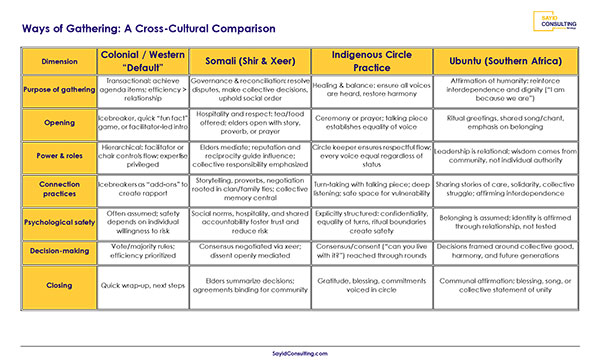
This article explores a foundational assumption in facilitation: that there is a “right” way to gather, participate, and make decisions. Drawing on Ways of Gathering: A Cross-Cultural Comparison, it examines how different cultural traditions approach core elements of facilitation, including purpose, trust, participation, and decision-making.
By placing these approaches side by side, the piece highlights that what is often considered “best practice” is not neutral, but shaped by specific cultural logics. It invites facilitators, leaders, and practitioners to expand their understanding of participatory practice and to recognize that multiple valid ways of gathering exist, each rooted in different values and relational frameworks.
Table of Contents
There is a quiet assumption
There is a quiet assumption that sits underneath much of facilitation practice. It is the idea that there is a right way to gather, a right way to open a session, a right way to build trust, and a right way to move people toward decisions. This assumption is rarely stated directly, yet it shapes how agendas are designed, how success is measured, and how the craft itself is practiced.
At the same time, many facilitators share a common foundation. There is a widely held belief that good process creates the conditions for meaningful participation, that every voice matters, and that stronger decisions emerge when people move beyond positions toward shared understanding. These ideas have shaped how many of us design and hold space, often without us needing to question them.
A simple, unsettling question
Ways of Gathering: A Cross-Cultural Comparison emerged in conversation with that foundation.
It began with a simple curiosity, but one that felt increasingly difficult to ignore: what if what we call “best practice” is not neutral, but cultural? And what if it is only one expression among many, shaped by particular histories, values, and ways of relating that have become dominant in certain spaces?
Placing approaches side by side
The resource brings together different cultural approaches to gathering and places them alongside one another in a structured way. It looks at familiar dimensions such as purpose, opening, power and roles, connection practices, psychological safety, decision-making, and closing, and explores how each of these takes shape across contexts.
What becomes visible through this is not a hierarchy of better or worse approaches, but something more interesting. You begin to see that each approach is internally coherent. Each one makes sense on its own terms. Each one is answering the same questions, how do we come together, how do we listen, how do we decide—but from a different starting point.
Shared intentions, different paths
Across cultures, there is a shared intention to create conditions where people can participate meaningfully, where decisions can be made collectively, and where the group can move forward with some level of alignment. What differs is how those conditions are created and sustained, and what is considered essential along the way.
In some contexts, participation is structured through facilitation techniques that ensure balanced airtime and clarity of process. In others, participation is not something that needs to be engineered in the same way; it is held through practices like storytelling, ritual, or turn-taking that already carry expectations of voice, presence, and responsibility.
In some spaces, trust is something that must be intentionally built within the session. In others, it is not confined to the session at all. It is grounded in systems of hospitality, reciprocity, and shared identity that exist before people ever enter the room.
Decision-making reflects this as well. Whether through voting, consensus, or relational negotiation, the underlying aim is often similar: to arrive at outcomes that people can stand behind and move forward with together. What differs is the pace, the process, and the meaning attached to agreement.
When familiarity is mistaken for truth
Seeing these approaches side by side has a way of gently unsettling certainty.
It invites a recognition that what feels natural or effective is often simply what we have been most exposed to. A gathering that prioritizes efficiency and clear outcomes reflects one set of values, just as a gathering rooted in relationship, ceremony, or collective identity reflects another.
Neither is inherently more valid. But they are not interchangeable.
From defaults to choices
What this resource has opened up for me is not a new method, but a different kind of awareness. It has made it easier to see that facilitation is not just a set of tools or techniques. It is a practice shaped by assumptions about time, power, voice, and relationship, assumptions that quietly define what is possible in a room.
When those assumptions remain invisible, they become defaults. When they are visible, they become choices.
An invitation to the craft
That shift does not require letting go of what we have learned. Instead, it creates space to hold multiple truths at once, and to recognize that different contexts may call for different ways of gathering, each with its own integrity.
And perhaps that is the invitation.
Not to search for the right way to facilitate, but to become more aware of the many ways that already exist, and to engage with them with greater intention.
Exclusive Download
Ways of Gathering: A Cross Cultural Comparison